Report: Enaam Alnour
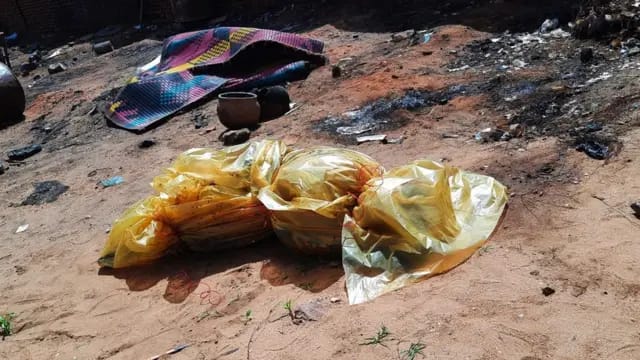
For two weeks, the body of Tariq Bahr aldeen lay in front of his house in the al-Tadamun neighborhood of al-Junaynah, the capital of West Darfur state. His family knew his whereabouts but could not reach him; snipers and fighting that had engulfed the city made attempting to retrieve the body a risk that could add to the number of dead.
When it became possible to reach Tariq, he was taken to the forest cemetery. But he did not receive a single grave. He was buried in a mass grave with others.
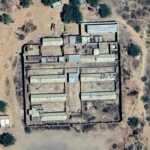
Within a few weeks in 2023, El Geneina was transformed into a city where death dictated its burial places. Known cemeteries were no longer the only destination for bodies; as the fighting intensified and cemeteries became often inaccessible, the dead were buried wherever possible: in house courtyards, in neighborhoods, along roadsides, and in hastily dug mass graves. In the forest cemetery alone, at least a thousand people were buried in just over seven weeks.
This report traces what remains after the war dead are buried; it examines what years of rain, floods, and the return of residents have done to these sites, and what they may conceal underground in terms of potential environmental hazards, forensic evidence, and clues that may lead families of the missing to the fate of their loved ones.
They buried their dead wherever they could
Tariq’s case was not unique. Human Rights Watch documented testimonies from ten people who participated in or witnessed the burial of approximately 3,900 people in El Geneina between April 24 and June 15, 2023, while satellite imagery showed an increase in the number of graves in six cemeteries in the city. After mid-June, reports of other mass burial sites in and around the city continued to emerge.
Burials were not always possible in city cemeteries. In El Geneina, Human Rights Watch documented instances where the Rapid Support Forces and allied militias prevented burials and threatened people who tried to access bodies, forcing some families to bury their dead inside their homes. In El Fasher, the siege and fighting made access to public cemeteries impossible at various times, leading to the appearance of graves within neighborhoods and mosques. In Nyala, human rights sources documented bodies left in the streets and others hastily buried during the fighting.
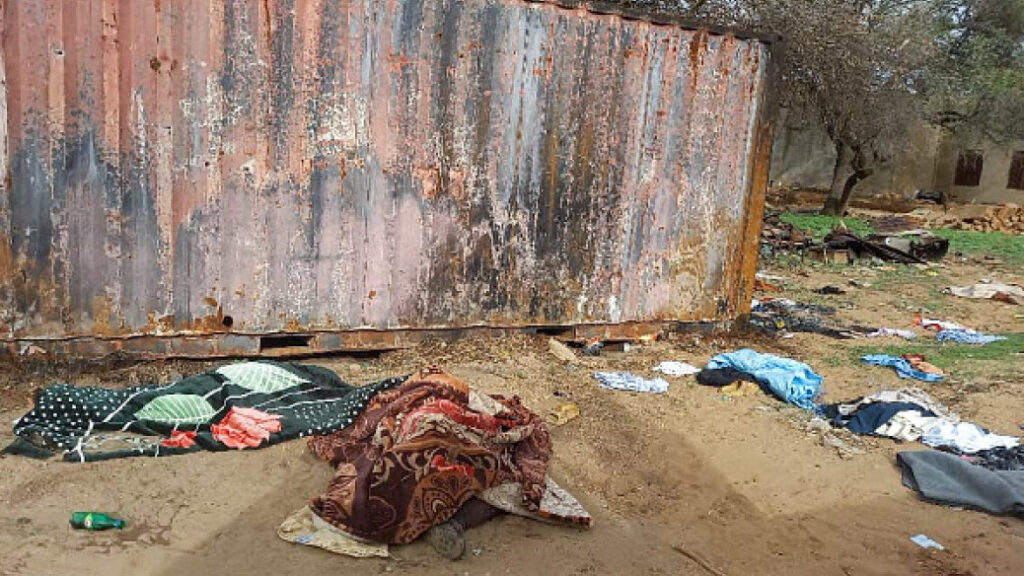
But some of the dead never even reached the cemeteries. In the Tadamon neighborhood, the body of a member of the “S.A.” family remained inside their home because the fighting made going out too risky; those who left might not return. She says, “The body stayed with us, and we couldn’t take it out. The road to the cemetery was dangerous, and anyone who went out might not come back. In the end, we dug a hole in the courtyard of the house and buried him there. We didn’t know how deep the water was, and we weren’t thinking about the rain or the soil. We had no other choice.”
The fighting around the house ended, but the story of the grave did not. When autumn came, rainwater began to enter the yard and run close to the burial site. “What we did to preserve the dignity of our dead during the war has become something we don’t know how to deal with now that life has returned,” says “S.A.”
In other parts of El Geneina, volunteers were dealing with even larger numbers of bodies. A volunteer from Accident Street says the problem wasn’t choosing the best burial place, but reaching the dead and returning alive. “There were huge numbers, sometimes bodies that lay for days. Whenever we had the chance, we’d go out and bury as many as we could. The war dictated where and how we buried them.” Years later, he still remembers some of the spots, but the land itself has changed. “Some of the markers have disappeared. The rain has altered the soil, and some areas have been repopulated. I fear the day will come when no one will know that beneath these places lie people buried during the war.”
The bodies on the escape route
The geography of burial was not limited to the city and its cemeteries. On the road that connects El Geneina to the Chadian city of Adré lies the area of ”Mara Jerbi,” which is a point on one of the most important routes for leaving West Darfur towards the Chadian border; the same road that was crossed by large numbers of fugitives and refugees during the waves of violence that swept through the state.
“T.A.” was one of those who took that route. She says that her father paid large sums of money to members of the Rapid Support Forces to get her out of El Geneina. But she did not leave the city in a vehicle carrying only those fleeing; she found herself on board a four-wheel drive vehicle that, according to her estimate, was carrying more than fifty bodies.
The vehicle continued on its way until it reached Mara Gerbi. There, T.A. witnessed what had remained etched in her memory since the escape journey. A large pit had been prepared before the vehicle arrived. She says, “When we reached Mara Gerbi, they changed vehicles. There was a large pit already prepared. They dumped the bodies into it and buried them. The people who were doing this were wearing Rapid Support Forces uniforms.” After the burial, T.A. was transferred to another vehicle and continued on her way towards Adré.
In a separate incident, the United Nations documented the burial of at least 87 people, including women and children, in the “Red Dust” area near El Geneina during June 2023. According to published information, 37 people were buried on June 20 and another 50 the following day, in a mass grave estimated to be about one meter deep.
What death leaves behind underground
But closing the graves did not end the effect of those emergency decisions. Seasons of rain and drought followed one another, water moved over and inside the surface, and some of the markers that the residents had placed on the graves disappeared, while people returned to neighborhoods and homes that had been the scene of burials.
Satellite images give this fear a visible form. In possible mass burial sites north of the road linking El Geneina and the Chadian border, images showed a clear change between May and July 2023, as parts of the area were flooded with the onset of the rainy season.
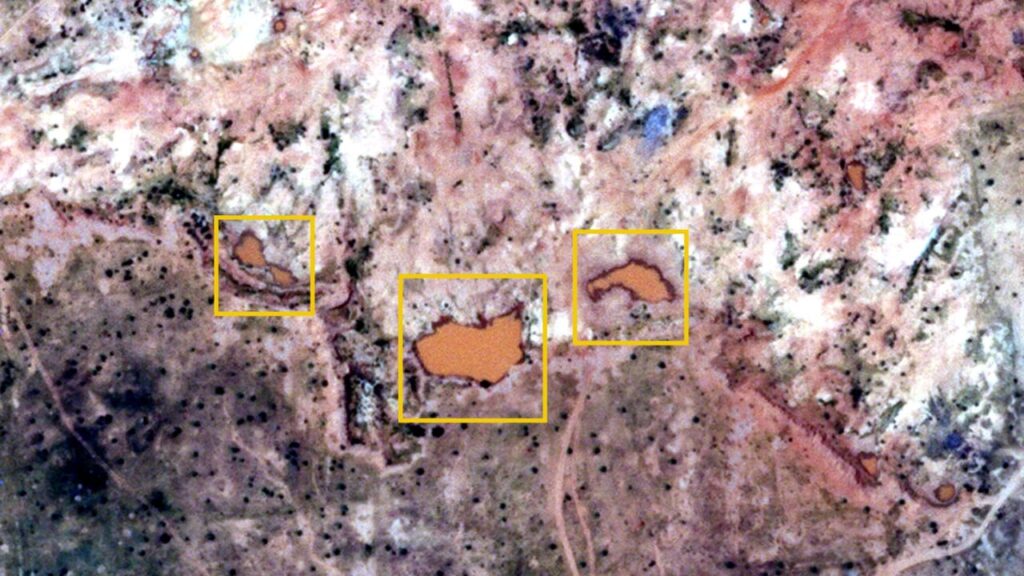
One of the area’s residents recalls the scene from the ground: “We knew that there were bodies buried in this area, and some of them were not deep. When autumn came, the pits and depressions filled with water, and you could no longer tell where the burial ended and where the rainwater began. The water was moving from place to place, and people at that time were not thinking about pollution; they were just trying to survive.”
He says the concern arose later, when water continued to collect around sites known to have been used for burials: “After the situation calmed down we started asking: This water passed over land where people were buried, so where did it go after that? We can’t say that it contaminated the wells, but no one came to examine the water or soil and tell us what happened.”
The World Health Organization and the International Committee of the Red Cross confirm that the bodies of people who die from gunfire, shelling, and injuries sustained in conflicts do not typically cause epidemics. The environmental problem is more specific: in certain circumstances, a burial site can become a concern when it intersects with water sources, groundwater, or surface runoff.
After death, tissues begin to decompose, producing fluids and organic compounds that enter the surrounding environment. However, their presence in the soil does not necessarily mean they have reached the drinking water supply. Between the body and the water source lie layers of soil and rock, and the movement of these substances varies depending on soil permeability, grave depth, groundwater depth and direction, slope, rainfall, and burial density.
Professor Ismail Abdullah, a specialist in hydrology and water resources engineering, rejects the notion that the presence of a mass grave is automatic evidence of water pollution. He explains that assessing any site begins with the nature of the land itself, not just the number of bodies.
He says: “The presence of a mass grave does not necessarily mean that the surrounding water is contaminated. To determine the risk, we need to know the type of soil and its permeability, the depth of the grave and the groundwater, the direction of its movement, the nature of the slope, and the amount of rain and floods that the site has been exposed to. It is the water that determines the path of potential pollutant transfer, not geographical proximity alone.”
He adds: “There may be a well near the burial site, but the groundwater flow is moving away from it, while there may be a more distant water source located in the direction of the flow. Therefore, the danger cannot be determined by distance alone; it must be known whether there is a path that allows the decomposition products to be transferred from the burial site to a source used by the population.”
According to Abdullah, emergency burial sites become more critically assessed when they are shallow, located in highly permeable soil, in flood-prone areas, or when groundwater is close to the surface. He adds, “This is why, under normal circumstances, cemeteries are chosen based on considerations related to soil, water, and topography. But during the war, people buried their dead wherever they could reach, not necessarily in the most environmentally suitable location.”
According to Abdullah, these conditions do not necessarily mean that pollution has actually occurred. “Proving pollution requires examining the site, taking water and soil samples, and comparing them to other potential sources of pollution. But when we have an emergency burial, and then the site experiences seasons of rain and floods, these are sufficient scientific reasons to examine it, and not a presumptive proof that it is polluted.”
Dr. Mustafa Othman, an environmental health specialist, warns against turning this gap into panic. He says, “The war destroyed water and sewage networks, waste accumulated, and sources of pollution multiplied. If we find bacteria or nitrates in a well near a grave, we need comparative samples and information on the direction of water flow.”
Khartoum… the city that rises above its graves
What happened in El Geneina was repeated in a different way in Khartoum. Within the capital, the collapse of services and the danger of accessing cemeteries led to the emergence of burial grounds in homes, squares, schools and other places that were not originally built to receive the dead.
Dr. Ahmed Othman was forced to bury a relative here when access to the cemetery became impossible. He says, “We buried him here because we couldn’t reach the cemetery. When we returned after the war, I no longer saw the courtyard the same way. This is our home, but it has also become a grave.” Later, the remains were exhumed and reburied, but Othman says that for him, the place is no longer just land.
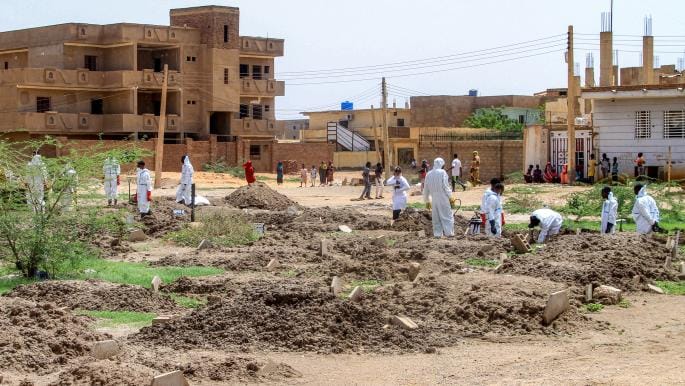
By April 2026, the International Committee of the Red Cross reported that more than 20,000 bodies had been recovered and buried in Khartoum alone. This figure does not imply that all of these bodies were unidentified or buried in mass graves, but it does reveal the scale of the task facing a city where large parts of its system for managing the dead had collapsed.
Amidst this void, grassroots initiatives emerged, including the “Unidentified Persons Initiative” at Al-Naw Hospital in Omdurman. Sami Talaat explains that volunteers received bodies whose identities were unknown, but they understood that behind each body lay a family searching for them. Therefore, they photographed the deceased, preserved their belongings, and documented as much as possible before burial. “At that time, the telephone became a substitute for entire institutions that had ceased functioning due to the war.”
The initiative stated that it buried 8,870 unidentified bodies over a 30-month period, mostly in Omdurman, and that families were able to identify 263 of them. The significance of the initiative’s work lies not only in the number of bodies buried, but also in the archive it created: a photograph of the body, its belongings, the location where it was found, its burial place, and any information that could connect an unknown person today to a family searching for them tomorrow.
Talat says, “We buried thousands, but for us, they weren’t just numbers. Every picture was a possibility that a family might come a month or a year later and say, ‘This is our son.’” He believes that losing the number, location, or picture makes finding the person later much more difficult.
When the grave markers disappeared
Salem Ibrahim participated in exhuming remains after residents returned to some areas, and he says that not all the markers placed over the graves during the war remained. Rain came, the land changed shape, and construction resumed in some places. In some cases, finding a grave again depended on someone remembering the location of the hole.
Here, the grave becomes more than just an environmental issue. For Dr. Adam Elmahy, a former forensic expert and mass grave specialist, the grave also represents a stage that can hold information about the victims’ identities and how they died. The position of the body, its clothing, belongings, injuries, and its relationship to other bodies could all be part of the evidence.
Al-Mahi warns that allowing bulldozers to enter before forensic teams might later allow for the collection of bones, but it could destroy the context in which they were found, information that may never be recovered. He summarizes the relationship between dignity and evidence by saying, “Reburial in a dignified manner is important, but dignity does not mean erasing evidence.”
The issue becomes even more pressing when considered alongside the file of missing persons. As of late March 2026, the International Committee of the Red Cross and the Sudanese Red Crescent were dealing with more than 11,000 missing persons cases related to Sudan, including cases dating back to before the current war. These cases should not be equated with the more than 20,000 bodies recovered and buried in Khartoum; not every missing person is deceased, and not every body is unidentified. But these two figures reveal the vast gap between the deaths that have been dealt with and the families who are still searching.
In Kalakla, news of bodies being exhumed becomes a personal possibility for Samia Ibrahim. “Every time I hear about bodies being exhumed from a mass grave,” she says, “I think my son might be among them. For people, these are just numbers: a hundred bodies, a thousand bodies, ten thousand. For me, every number could be the person I’m waiting for.” For her, knowing the death itself is less painful than the continued uncertainty: “I want to know where his grave is.”
When construction returns to the land of the dead
Meanwhile, Khartoum began moving in another direction: the return of residents, the removal of the war’s scars, and reconstruction. Suleiman Ibrahim, an urban planning engineer in Khartoum, believes that burial sites cannot remain a separate file within the forensic medicine department, as information about them must also reach the authorities planning roads, water infrastructure, schools, and buildings.
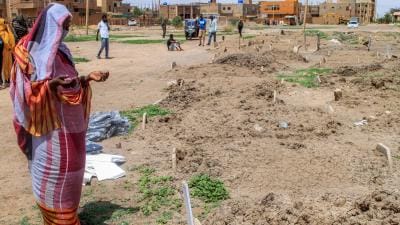
Ibrahim says: “If we don’t have a single map of the sites, work can start on land where neither the contractor nor the engineer knows that remains were buried there during the war.”
Testimonies gathered for the report indicate that some of the markers that identified burial sites disappeared over time due to rain and the return of residents. Volunteers involved in the burials and exhumations said that accessing some graves later relied on the memories of people who were present at the time of the burial, after the site had changed or the markers had disappeared.
What the war buried has not disappeared
In El Fasher, Salha Ibrahim doesn’t need maps or numbers to understand the meaning of loss. Her husband is still missing. “I’m not looking for a number among the dead,” she says. “I’m looking for someone with a name, a face, and a home. If he’s alive, I want to know where he is. If he’s dead, I want to know where he’s buried. The war took him from me once, and I don’t want oblivion to take him a second time.”
Satellite images have shown signs of “mass graves” and “body disposal activities” in the city of El Fasher, after the Rapid Support Forces took control of it, according to the Humanities Research Laboratory at Yale University.
After more than three years of war, the issue of the dead is no longer limited to the moment of burial alone. Some graves have been altered, some remains have been exhumed and reburied, while families are still searching for their missing loved ones, and cities are gradually returning to life on land whose function has changed during the years of fighting.
Tariq Bahr al-Din was one of those whose journey ended in that land. His family waited two weeks until they could reach his body, then buried him with others in a mass grave.
The grave was closed over Tariq, but the traces of war were not closed with him. What was hastily buried beneath the soil of Sudan remains part of its environment, its memory, and its evidence.
“This project was produced as part of the second edition of the Climate Journalism Diploma, organized by the Climate School with support from the Arab Fact-Checkers Network (AFCN)”